

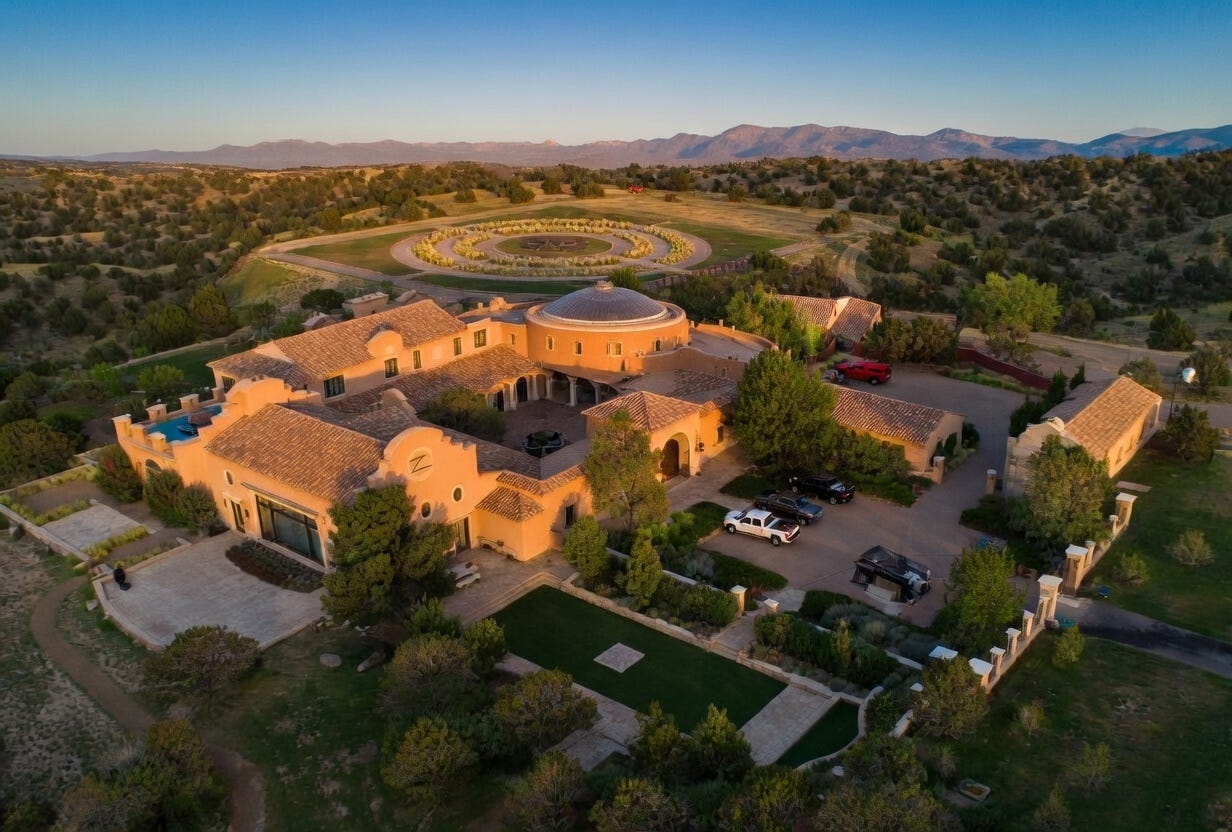
The FBI searched Epstein’s Manhattan mansion in 2019. His Palm Beach estate. His private island in the U.S. Virgin Islands. All three received warrants. All three were raided.
They did not search Zorro Ranch.
We now know why. Thirteen days after Epstein’s death, an FBI agent wrote to the bureau’s New York criminal division chief explaining that the bureau had interviewed “one victim who may have been raped at the NM residence” and lacked probable cause for a search warrant. At least a dozen accusers had named the ranch by that point. The agent added that any search at that stage “would be futile.” No warrant. No search. Case closed on a memo.
That email is in the DOJ file releases. It is public.
The first search of Zorro Ranch happened in March 2026. Not by the FBI. By New Mexico state investigators. Thirty years after the first documented complaint.
This is everything we know.
The Transaction That Started Everything
On February 22, 1993, the New Mexico State Land Office granted an agricultural lease to Zorro Trust, a shell company for Jeffrey Epstein. His listed address was a Manhattan office building. That same day, Zorro Trust completed a purchase of land from the King family, one of the most powerful political dynasties in New Mexico.
Bruce King had served three terms as Governor. His family sold Epstein the land for around $12 million. The King family name appears in Epstein’s “Little Black Book.” Bruce King’s son Gary became New Mexico’s Attorney General in 2007, serving until 2015. Epstein funneled over $35,000 to Gary King’s campaigns, routing donations through shell companies connected to Epstein’s private island address specifically to avoid press coverage. Gary King ran publicly on a platform of prosecuting child sex offenders. He also flew on Epstein’s private jet. He returned the donations in 2014 when they became public and said he did not remember meeting Epstein, and did not know whose jet it was.
Epstein donated $50,000 to Governor Bill Richardson’s reelection campaign in 2006, $15,000 to Gary King’s 2006 AG campaign, and $10,000 to Jim Baca’s 2006 campaign for state land commissioner. He covered every level of the regulatory structure that might one day scrutinize his property.
He was not building friendships. He was buying institutional protection.
What He Built
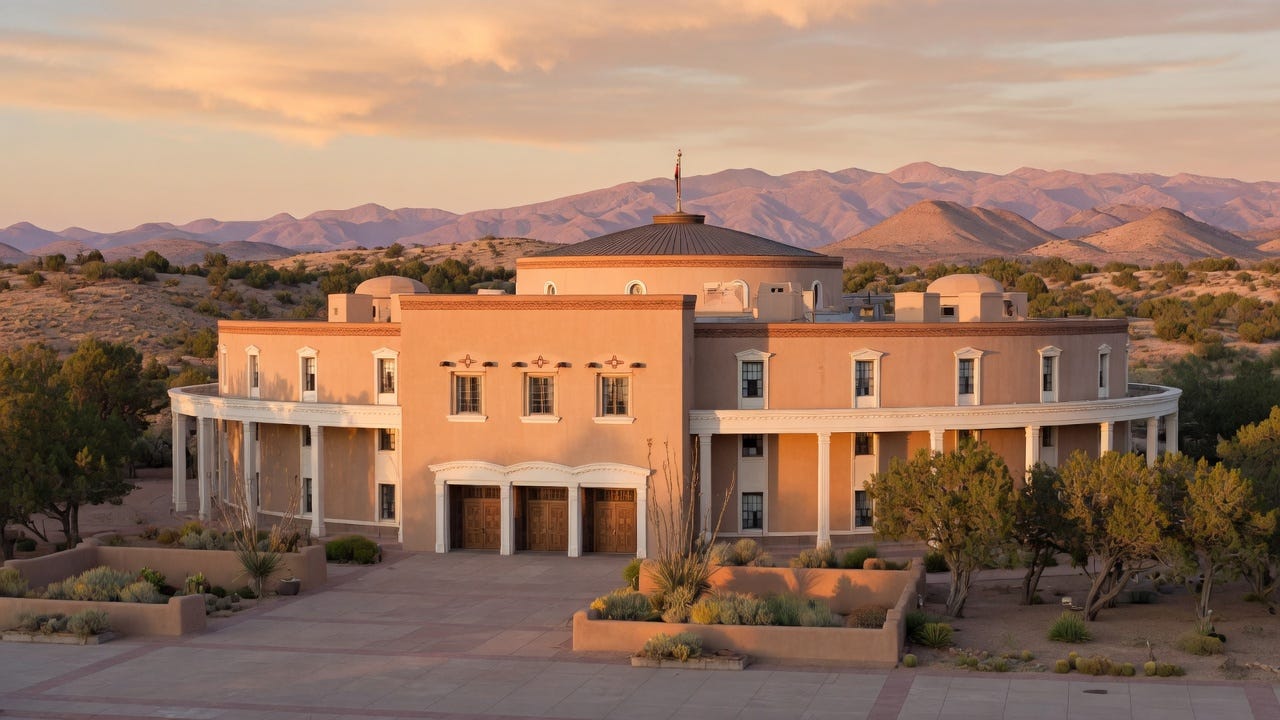
The compound Epstein constructed on that land was not a ranch. It was a private fortified facility, designed around access control and isolation.
By 1999, the property included a 28,636-square-foot mansion built in hacienda style, three stories high, with a living room the size of an average American home, multiple libraries, galleries, an elevator to the second-floor master suite, and a basement with an exercise room, massage room, and jacuzzi. The grounds held a private airstrip, a helicopter pad, an airplane hangar, a firehouse, offices, a log cabin, guest houses, a pool, and an antique railroad car on private tracks.
The private airstrip was structural. It allowed arrivals and departures without passing through any commercial airport, generating no public flight record. No comprehensive public visitor log exists, despite hundreds of documented flights in and out over two decades.
The property was known locally as “the playboy ranch.” Residents described “caravans of glamorous women” arriving via Highway 41. A Santa Fe photographer who had watched the compound since the late 1990s told reporters that locals knew when Epstein was at the ranch because the mansion lights drowned out the stars. One local journalist wrote in 1999 that the property placed “inordinate burdens on the scenic and water resources” of the region.
He expanded in 2001. Expanded again in 2004.
He also had Indigenous petroglyphs physically removed from surrounding land to decorate the property, destroying cultural sites. The All Pueblo Council of Governors called it “deeply troubling” and connected it to the broader pattern of predatory behavior toward vulnerable communities.
The Public Land Buffer
Beyond his private acreage, Epstein leased 1,243 acres of New Mexico public land through Cypress Inc. for $872 per year. The leases dated to 1993. Filings recorded roughly 40 head of cattle on the property, but the state AG later concluded those leases were obtained “through illegitimate means for purposes other than ranching or agriculture.” There was no evidence Cypress Inc. was any kind of livestock operation. The land served one documented purpose: a buffer zone around the estate that Epstein controlled through a public lease he should never have received.
In 2019, State Land Commissioner Stephanie Garcia Richard drove to the ranch twice to inspect the public land. Both times the gates were locked. Both times she was refused entry. She later described the state land as having been used “almost as a shield to hide what activity was occurring on the ranch.” She canceled the leases in September 2019. By then, Epstein was already dead.
The state of New Mexico had provided a subsidized privacy perimeter around a property where abuse was alleged for decades. After Epstein’s 2008 sex crimes conviction in Florida, he was not required to register as a sex offender in New Mexico. The state continued leasing him the buffer land anyway.
Workers Were Paid to Keep Silent
Ranch staff were required to sign non-disclosure agreements. The penalty for violation was $100,000.
A construction worker who helped dig the basement told ITV News he met Epstein during the work and immediately took a dislike to him. He and other laborers scratched the $100,000 figure from the NDA and replaced it with $1. A local contractor named Jim Sloan was offered excavation work, read the clause, found it suspicious, and walked away from the contract.
A firefighter named Ezra Sage told ITV News his father warned him as a child, driving past the ranch on Highway 41, that the man who owned it “did things to little girls.”
The open secret in the high desert had been running for years. The NDA was not preventing knowledge. It was preventing documentation.
The Survivors
Annie Farmer was 16 years old in the spring of 1996 when Epstein and Ghislaine Maxwell flew her from Arizona to Zorro Ranch. She believed the trip involved a summer volunteer opportunity in Thailand. She found herself alone at the compound, miles from anyone she knew. Maxwell took her shopping for expensive cowboy boots, then to a movie where Epstein caressed her hand and touched her thigh. Maxwell then gave her a topless massage. That night, Epstein climbed into her bed, pressed his body against her, and said he wanted to “cuddle.” She escaped by saying she needed to use the restroom.
Her older sister Maria had already been working for Epstein in New York and reported him to the FBI that same year, filing a criminal complaint about photos he had stolen of her younger siblings. Maxwell threatened to “burn her house down” and destroy her career. Maria changed her name and lived in isolation for over twenty years, fearing for her life. The FBI documented her complaint. It appears in the DOJ files, stamped September 3, 1996. The FBI took no meaningful action. In May 2025, Maria filed a federal negligence lawsuit against the U.S. government arguing that the FBI’s failure to investigate her 1996 report allowed over 1,000 subsequent victims to be harmed. Annie testified as the fourth and final accuser at Ghislaine Maxwell’s 2021 sex trafficking trial. She is now a licensed psychologist.
Virginia Giuffre described Zorro Ranch as “Disneyland” in her memoir, writing about “manicured grounds and gurgling fountains, a tennis court, and a grass airstrip and hangar.” Epstein called the main house his “castle.” Giuffre testified in a 2016 deposition that Maxwell instructed her to give former Governor Bill Richardson “massages” at the ranch, and that when Maxwell said massage, she meant sex. Richardson denied it. He died in 2023. The DOJ files released in 2026 show Richardson was still seeking dinner with Epstein in 2016, eight years after the first conviction. Virginia Giuffre died by suicide in 2024. She never saw an accounting of what happened to her at that ranch.
A woman identified only as “Jane” testified at Maxwell’s 2021 trial that she was flown to Zorro Ranch at 14 years old and forced to participate in orgies. Chauntae Davies said she was raped there at least twice. Former Santa Fe massage therapist Rachel Benavidez testified she was sexually abused when hired to work at the property. Ranch managers Karen and Brice Gordon hosted large parties there multiple times a year. After Epstein’s 2019 arrest, the Gordons went into hiding, reportedly fearing for their lives. A housekeeper stated Prince Andrew visited for three days in 2001. New Mexico Truth Commission Chair Andrea Romero told ITV News she believes it is “likely” Prince Andrew visited and has expressed interest in having him testify. Joshua Ramo, then CEO of Kissinger Associates, visited the ranch in 2014 for a lunch meeting with MIT and Harvard professors, one of several documented high-profile visits that have never been fully accounted for. Former Barclays CEO Jes Staley is documented in flight logs as having spent considerable time there.
Nearly a dozen accusers named Zorro Ranch specifically. Epstein was never charged with a crime in New Mexico.
The Stated Plan for the Ranch
This part does not receive enough coverage.
In 2019, The New York Times reported that Epstein had told multiple scientists over several years that he planned to use Zorro Ranch as a facility to “seed the human race” with his own DNA. His stated plan was to impregnate twenty women at a time at the property. He modeled the scheme on the Repository for Germinal Choice, a real eugenics sperm bank founded in 1980 by eugenicist Robert Graham and intended to be stocked with Nobel laureate sperm. It closed in 1999. Epstein wanted his own version, with only his DNA. He also told one transhumanist he wanted his head and penis cryogenically preserved after death to allow for future resurrection.
The DOJ files released in January 2026 added harder edges to the ideology. He catalogued conference attendees by eye color, believing blue eyes were a marker of intelligence. He sought blue eyes in the women brought to his properties. His 2016 emails to Noam Chomsky invoked racialized theories about cognitive differences as “uncomfortable facts” requiring acceptance. He donated $6.5 million to Harvard’s Program for Evolutionary Dynamics and $20,000 to the Worldwide Transhumanist Association. He flew Stephen Hawking, Oliver Sacks, Murray Gell-Mann, and Frank Wilczek to his properties on private jets.
Epstein himself explained his reason for choosing New Mexico in a 2019 interview. He said Los Alamos National Laboratory was losing physicists to private spin-off firms, companies he called the “info mesa.” He wanted to be near that scientific community. For more on Epstein’s relationship with frontier physics and the scientists he cultivated, read While the World Focused on Epstein’s Island, His Scientists Were Working on Something Else.
The ranch was not a remote escape. In his own telling, it was a eugenics facility, positioned adjacent to a network of scientists he had spent years building access to.
Two Offices Pushed to Search. Both Were Overruled.
When Epstein was arrested in July 2019, New Mexico AG Hector Balderas opened a state investigation and wrote to federal prosecutor Maurene Comey, daughter of former FBI director James Comey, offering to assist. Federal prosecutors told New Mexico to stand down. The state closed its investigation.
The U.S. Attorney for the District of New Mexico was also pressing the Southern District of New York to search the ranch. Both the state AG and the federal office with jurisdiction over New Mexico were being overruled by New York prosecutors.
Thirteen days after Epstein’s death on August 10, an FBI agent wrote to Michael Driscoll, special agent in charge of the New York FBI criminal division, explaining the decision not to search. The agent stated the bureau had interviewed “one victim who may have been raped at the NM residence” and lacked probable cause. One accuser. The agent also wrote that any search at that point “would be futile” because useful evidence had likely already been removed.
Two tips arrived in the weeks that followed. The first, in November 2019, was the email to radio host Eddy Aragon claiming two foreign girls had been buried on the property on Maxwell and Epstein’s orders, both allegedly having died by strangulation during rough sex, with seven videos held as insurance. The second was a communication from a retired New Mexico State Police officer flagging a suspicious barn on the property containing what appeared to be a concealed incinerator. The FBI received both. Neither produced a search warrant.
Balderas sent a second letter in July 2020 asking the feds to seize the ranch so proceeds could go to victims. He received no reply. He left office in 2022. His final public statement: “They essentially gutted our ability to aggressively seek justice for victims.”
Representative Melanie Stansbury, a member of Congress who has reviewed the unredacted Zorro Ranch files, said to reporters: “There aren’t words to describe what are in those files.” After sitting through AG Pam Bondi’s closed-door hearing in 2026, Stansbury wrote publicly: “If anyone wondered whether there is a coverup, there is a coverup happening in the Department of Justice and in the White House.”
There is no record in the DOJ’s 3.5 million released pages of any federal search of Zorro Ranch. Ever.
Maurene Comey, who told New Mexico to stand down, was fired by the Trump administration in July 2025.
The Fraudulent Deed
In 2020, a deed appeared in Santa Fe County records transferring Zorro Ranch from Cypress Inc. to a Christian non-profit called “Love and Bliss” for $200, bearing a signature stamp for Jeffrey Epstein, dead for over a year. Every contact on the document was fabricated. The attorney’s address was a real estate office. The listed phone number had belonged to the same sales company for sixty years.
The man behind it was Alexander Leszczynski, a Florida resident who ran a nationwide property fraud operation using fake charitable entities, targeting dormant high-value estates. He had filed a fraudulent deed on Epstein’s Palm Beach mansion simultaneously. A Florida judge declared that deed “invalid and unenforceable.” Served with a cease-and-desist, he filed a second fraudulent deed in Florida under a different name. He obtained two PPP pandemic relief loans through Love and Bliss totaling nearly $196,000. He was federally indicted on eight counts including wire fraud, bank fraud, and money laundering. After a local television station exposed him publicly, he was charged with attempting to hire a hitman to kill two federal witnesses. Murder-for-hire. Obstruction of justice. He was held without bail pending a psychological evaluation.
He has no connection to Epstein. But the estate was forced to spend money and court time clearing a fraudulent deed, while the ranch sat empty, the investigation had been stood down, and no law enforcement agent had searched the property in the thirty years since the first complaint.
The estate sold Zorro Ranch legitimately in 2023 to the Huffines family through an anonymous LLC. Renovation work began immediately. The property changed hands four years after Epstein’s death. The first search came three years after that.
New Mexico AG Balderas said it directly in 2021: “Clearly, he had political influence. We really should have been investigating past conduct, and unfortunately those cases were swept under the rug. It’s a black eye to the legacy of the state of New Mexico.”
The First Search, and What It Did Not Find
On March 9, 2026, New Mexico state investigators entered Zorro Ranch for the first time. New Mexico State Police and cadaver dog units from Sandoval County swept the grounds for human remains. Drones produced a 3D map of the estate. Construction was ordered halted.
No bodies were found.
A separate tipster sent photographs to state lawmakers claiming to show grave-like plots on the grounds. Al Jazeera obtained the correspondence via a public records request with the New Mexico DOJ. The images have not been independently verified.
Amateur investigators using LiDAR and satellite imagery had been publicly mapping the property for months before the search. One user in a Facebook archaeology group posted a video showing a circular subsurface pit on the ranch. Another commenter replied: “You have done more investigating than the FBI at this point.” The comment received over 4,000 likes.
Balderas, now out of office, said it plainly: “Clearly, he had political influence. We really should have been investigating past conduct, and unfortunately those cases were swept under the rug. It’s a black eye to the legacy of the state of New Mexico.”
The Truth Commission
New Mexico’s bipartisan Truth Commission was established by unanimous House vote in February 2026. Its four members have subpoena power. It is funded by a $2 million allocation from a $15 million settlement between the state DOJ and banks associated with Epstein. An interim report is due July 31. A final report by year end.
The commission seeks to identify ranch guests, state officials who may have known what was happening, and anyone who participated in alleged abuse. Prince Andrew is among the figures Romero has expressed interest in compelling to testify.
Commission Chair Andrea Romero said on the House floor that Epstein “was basically doing anything he wanted in this state without any accountability whatsoever.”
This Is How It Works
The GENIUS Act, currently moving through Congress with institutional backing from entities with documented Epstein connections, is part of the same structural picture. I covered how money and regulatory capture work together in that piece. The same machinery runs underneath both stories.
What Zorro Ranch shows is how institutional protection functions at the operational level. The governor who sold the land. The son who became AG and took the money. The land commissioner’s office that issued a subsidized privacy buffer for decades. The state with no human trafficking law until 2008. The 2008 plea deal that closed the New Mexico thread. The FBI agent who decided one accuser was not enough. The state AG and the federal district office both overruled by New York. Two tips about possible bodies, received and filed. The property sold before anyone looked.
None of that required conspiracy. It only required institutions doing what institutions do, protecting themselves and the people with money inside them.
The Questions Nobody Has Answered
We don’t know what the FBI determined, if anything, about either the buried girls tip or the incinerator tip.
We don’t know what the unredacted Zorro Ranch files contain. Representative Stansbury has read them. She says there are no words.
We don’t know what was altered between Epstein’s 2019 death and the first search of the property in 2026.
We don’t know the full visitor record. No comprehensive account of who passed through the private airstrip has ever been made public.
We don’t know what the Truth Commission will find. The interim report is four months away.
Maria Farmer filed her FBI report in 1996. Annie Farmer testified at trial in 2021. Virginia Giuffre died in 2024. The first search of the property they described happened in March 2026.
The facts are on the table.
What single detail about Zorro Ranch do you think deserves more coverage than it has received? Leave it in the comments.
If this reporting is useful to you, share it with one person who should know about it.
Subscribe to Strident Citizen to follow the Epstein investigation and the institutions that surrounded it.
Strident Citizen is independent and reader funded. No ads. No institutional backing. Every article is free to read. If this kind of investigative journalism matters to you, a paid subscription is the most direct way to keep it going.