

I want to tell you a story about timing.
Not the kind of timing that’s just a coincidence. The kind of timing that only makes sense when you understand how Washington DC really works.
In November 2023, Changpeng Zhao pleaded guilty to a federal crime. He admitted that under his leadership, Binance failed to maintain anti-money laundering controls on an very large scale. His company identified users who appeared to be involved in illicit activity and kept letting them use the platform anyway. Because they were VIPs.
Federal prosecutors wrote that
Binance’s failures allowed money to flow to terrorists, cybercriminals, and child abusers. Court records showed that
Binance executives joked openly about Hamas operatives using the service to buy weapons.
CZ paid a $50 million personal fine. Binance paid $4.3 billion, one of the largest corporate penalties in American history. Zhao went to prison for four months and was released in September 2024.
The DOJ called it a case of violations on an unprecedented scale. They asked for three years. The judge gave him four months.
That’s where most people think the story ends.
It doesn’t.
The Business Deals Start
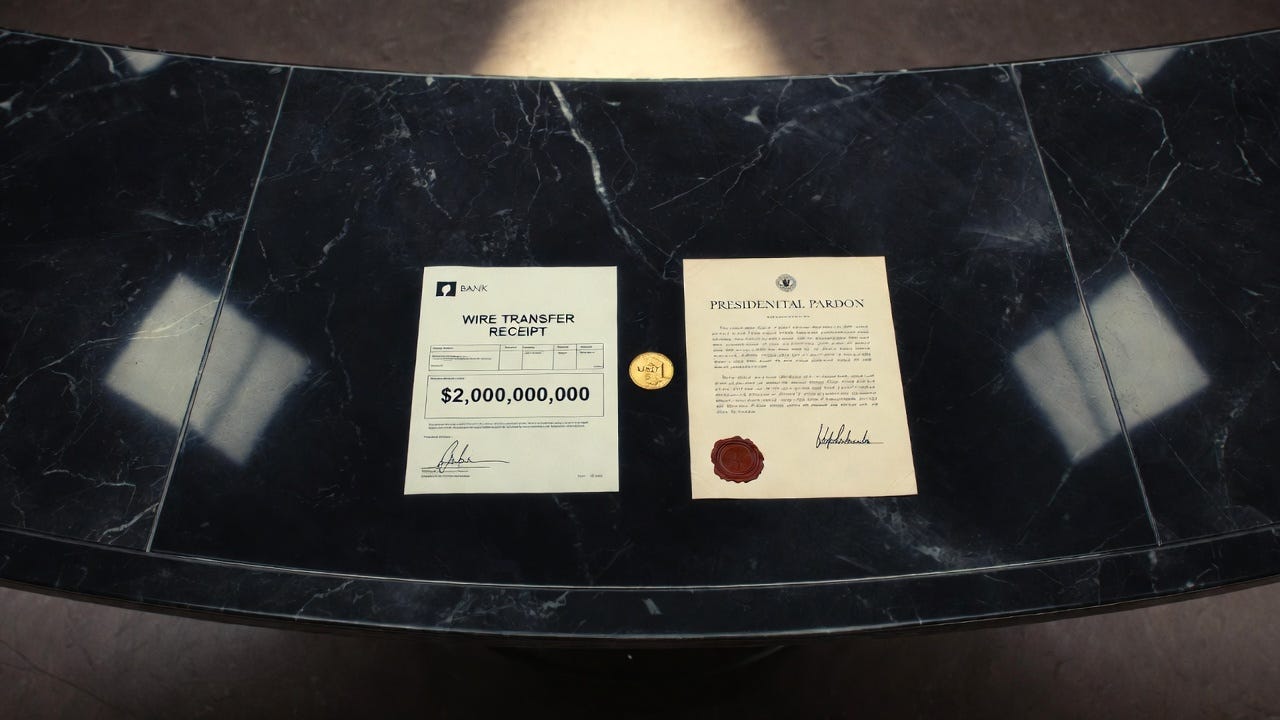
In March 2025, five months after Zhao walked out of prison, the Wall Street Journal reported that Binance was in talks with the Trump family about business dealings. At this point CZ is a convicted federal criminal on record as having enabled terrorist financing. And the family of the sitting president of the United States is opening business discussions with his company.
Take a moment with that.
In May 2025, a UAE government-backed investment firm called MGX announced a $2 billion investment into Binance. They used USD1 to do it. USD1 is the stablecoin issued by World Liberty Financial, the crypto platform co-founded by Eric Trump and majority-owned by the Trump Organization. The Trump family had made over $1 billion from World Liberty by late 2025.
So a foreign government-backed fund used the president’s family stablecoin to invest $2 billion into the company of a man who had recently pleaded guilty to federal money laundering violations. And that man needed a pardon.
By August 2025, the Wall Street Journal had a second story. Binance was now quietly running the backend trading infrastructure for World Liberty Financial. Not just a financial relationship. An operational one. The convicted money launderer’s company was running the plumbing for the president’s family crypto business.
This is the same regulatory environment the CLARITY Act is being built inside, and nobody celebrating it is asking who benefits most from the rules being written.
That same month, the New York Times reported that Zhao was actively campaigning for a presidential pardon. Funny timing.
The Lobbying
Binance spent $800,000 lobbying the White House for clemency and cryptocurrency policy issues.
They hired a firm called Checkmate Government Relations, run by Charles McDowell. McDowell is a friend of Donald Trump Jr. His firm disclosed it was paid $450,000 specifically for work that included lobbying the White House and Treasury Department for what they called “executive relief.”
Executive relief. That’s the phrase a paid lobbyist used to describe getting a federal conviction erased for the founder of the world’s largest crypto exchange.
In October 2025, McDowell met with Trump directly about a pardon for CZ. He got the introduction through Donald Trump Jr.
On October 23, 2025, Trump signed the pardon.
CZ posted on X: “Deeply grateful for today’s pardon and to President Trump for upholding America’s commitment to fairness, innovation, and justice.”
Eight days later, on 60 Minutes, Trump was asked why he issued the pardon. “I don’t know who he is,” Trump said. “I know nothing about the guy.”
The president of the United States did not know who he just pardoned. Despite the fact that this man’s company was literally running the backend infrastructure for his family’s crypto platform. Despite the fact that his son’s friend had personally brokered the meeting that led to the pardon.
He didn’t know who he was.
The Other Side
I want to be fair here, because this story is more complicated than it looks if you just read the headlines.
CZ did not steal from customers. He was not convicted of fraud. There were no identifiable victims in the way we normally understand that phrase. What he was convicted of was running a compliance operation that was deliberately inadequate while his company grew into the largest crypto exchange in the world. That is a meaningful distinction.
His lawyers made a reasonable point during sentencing. BitMEX founder Arthur Hayes committed a nearly identical violation and received probation. No prison time at all. The sentencing guidelines for Zhao’s crime called for 12 to 18 months. He was asked to serve three years. The judge rejected that, called it excessive, and gave him four months. The judge himself said he had never seen a prosecution push for a sentence so far outside the guidelines in his 30-year career.
CZ said at Davos in January 2026 that there was no deal. “There is a lot of media saying that there is some deal in place. As far as I know, that does not exist at all.” He said he has never spoken directly with Trump.
The White House framing has a kernel of truth in it too. The Biden DOJ did pursue crypto harder than arguably any administration in recent memory. Gary Gensler made a lot of enemies. Some of those enforcement actions were genuinely disproportionate, and the industry had real grievances. The argument that CZ was made an example of is not without merit.
So was this a witch hunt? Or was it pay-to-play?
That’s the question you need to sit with. Because both things can be partially true and the answer still tells you something important about how power operates.
This Wasn’t A One-Off
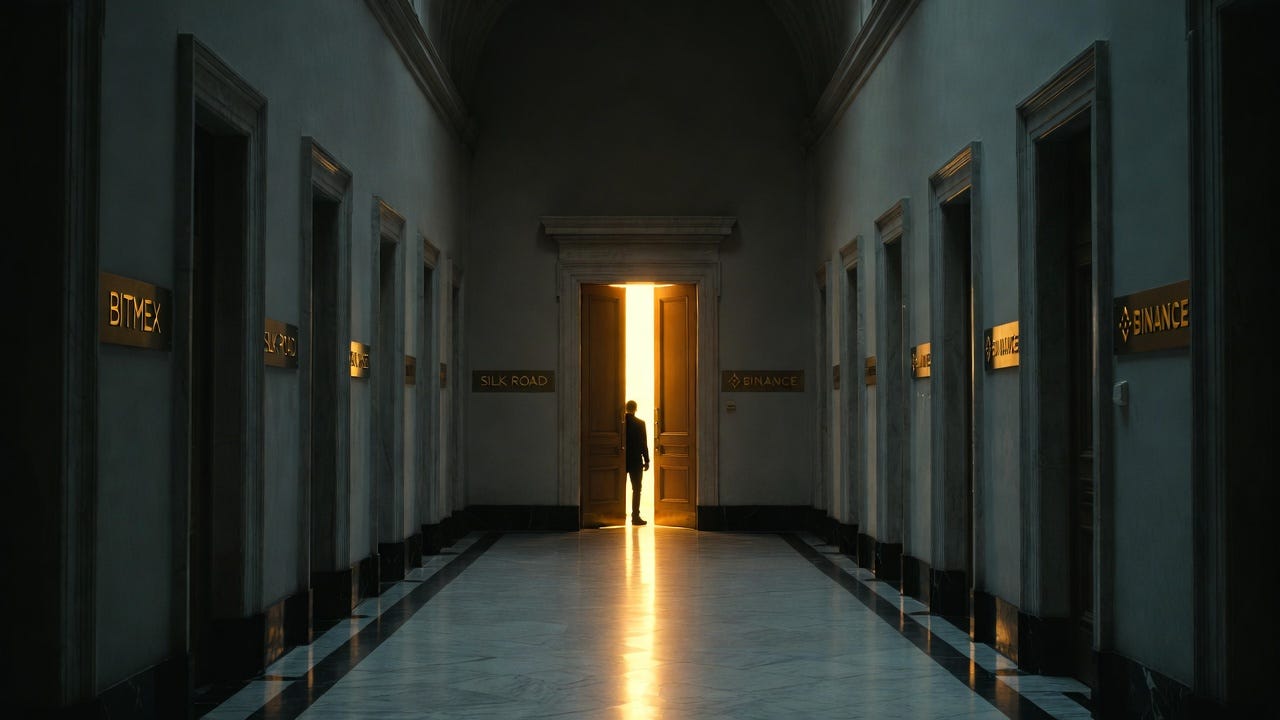
Here’s what makes the CZ pardon harder to dismiss as a political favor gone slightly too far.
Trump also pardoned three co-founders of BitMEX and a senior executive, all convicted of the same Bank Secrecy Act violation CZ was convicted of. He pardoned Ross Ulbricht, who built Silk Road, the dark web marketplace that ran on Bitcoin and facilitated hundreds of millions in drug sales. He has pardoned or commuted the sentences of 18 people convicted of fraud-related charges since taking office.
That’s not a coincidence. That’s a pattern.
At some point the individual cases stop being individual cases and start being a signal. The signal is that financial crime in the crypto space carries a different kind of risk depending on who is in the White House and whether you’ve made yourself useful to them.
CZ made himself useful. BitMEX’s parent company paid a $100 million fine to the CFTC and lobbied hard. Ulbricht had a libertarian movement behind him that showed up at the polls.
The question isn’t whether any one of these pardons was justified. Some of them probably were. The question is what it looks like when the pattern only runs in one direction, and the people who keep getting pardoned keep having some connection, financial or political, to the administration handing them out.
This is worth connecting to something I wrote about earlier this year. If you’ve been following along, the GENIUS Act was sold as regulatory clarity for the stablecoin market. What it actually did was create a legal framework that World Liberty Financial, the Trump family’s own stablecoin business, was largely carved out of. The pardons and the legislation are not separate stories. They’re the same story told in two different languages.
And if you want to go deeper on how government and Bitcoin have always had a more complicated relationship than either side admits, I covered that earlier this year too. The CIA/Bitcoin piece is worth reading alongside this one.
What The Timeline Actually Shows
Here is what we know happened, in order:
CZ pleads guilty. Serves four months. Gets out. Binance starts talking to the Trump family. Binance runs the backend for the Trump family stablecoin platform. A UAE government fund invests $2 billion into Binance using the Trump family stablecoin. Binance spends $800,000 lobbying for a pardon. The lobbyist is a friend of Trump’s son. The pardon happens. Trump says he doesn’t know who CZ is.
You can look at that sequence and decide it’s all coincidence.
Seven US senators wrote to the DOJ and Treasury after the pardon and said it plainly: “It appears that corporate criminals can violate the law, be found guilty, and face criminal consequences — but if they or other executives help the President enough, they can be cleared of wrongdoing.”
Meanwhile, the GENIUS Act, the legislation that governs stablecoins, was signed into law without any provision addressing the president’s conflicts of interest in the stablecoin market. World Liberty Financial, the Trump family’s stablecoin business, was largely carved out of meaningful regulatory oversight.
The SEC dropped enforcement actions against multiple crypto firms with financial ties to Trump ventures around the same time.
None of this is a secret. It’s all documented. It’s all public record.
Which raises the question.
If the rules don’t apply when you’re doing business with the right people, then what are the rules actually for?
As the quote goes, “Rules for thee, but not for me”
If this made you think, share it with someone who still believes the pardon was about justice.
Subscribe to Strident Citizen for investigative crypto coverage that follows the money.
What do you think — political favor, pay-to-play, or is the Biden witch hunt argument actually valid? Drop it in the comments.