


He’s on Interpol’s Most Wanted list. The people who invested in his project lost over 90% of their value. He beat the SEC in federal court. And he’s posting on X from an unknown location. The story of Richard Heart is either the greatest cautionary tale in crypto history, or could be the greatest comeback a founder has ever had.
There is a man who has been posting on X — and occasionally dropping static videos from an undisclosed location — who is simultaneously:
Wanted by Interpol
Listed on
Previously accused of beating a 16-year-old in a stairwell — charges since removed from Interpol’s website
Facing hundreds of millions in tax evasion charges from Finnish authorities
The legal victor over the most powerful financial regulator on earth
The founder of multiple crypto projects that raised approximately $1.7 billion from real outside participants
A legitimate donor of $27 million to longevity medical research
His name is Richard Heart. And if you’ve never heard of him, you’re about to understand why you should have.
The Origin Story Nobody Talks About
Before Richard Heart was a crypto philosopher, before he was dropping pearls of financial wisdom on YouTube in front of a green screen, before he was buying the world’s largest black diamond with money the SEC said wasn’t his — he was known as a spammer.
Born Richard James Schueler in Pittsburgh, 1979. Father fixed air conditioners. Kid was reading at age three, enrolled in a gifted program, learning Scheme programming in middle school. Brilliant by every measure.
By his mid-twenties he was running spam operations across the internet at scale. In 2002 he got sued under Washington State law for flooding inboxes with deceptive commercial emails. Called the plaintiff up and admitted it. Case went nowhere serious.
Then came Panama. In 2007, Panamanian civic activist Miguel Antonio Bernal published a Google Groups post in which he alleged that Schueler — operating under aliases including James Hart and J. Richard — was among a group of American nationals exploiting Panama’s legal system for financial gain. Bernal’s post described what he characterized as a pattern of predatory business conduct targeting local businessmen. These are allegations made by a third party in a public forum. Schueler was never charged or convicted of any crime in Panama, and the claims have not been verified by law enforcement. They are reported here solely as part of the documented public record of allegations made against him at the time.
Then one day, Richard Schueler ceased to exist. Richard Heart was born.
He took his money, moved to Europe, and started making YouTube videos about Bitcoin.
Building a Cult
You have to understand what Richard Heart was actually selling before you can understand why people bought it.
He wasn’t just selling tokens. He was selling a worldview.
The pitch: banks are parasites. Traditional finance is a system designed to keep regular people poor. Inflation steals your wealth silently, year after year, while the people who already have money make more of it doing nothing. He wasn’t wrong about any of this.
He had watched Bitcoin go from nothing to everything. He had called the 2017 peak. He publicly warned about Celsius, BlockFi, and FTX before they collapsed. People who listened to him made fortunes. People who dismissed him lost everything on platforms he’d told them were fraudulent.
By the time he launched HEX in December 2019, he had enormous credibility — and he used every drop of it.
HEX was marketed as the world’s first “blockchain certificate of deposit.” Stake your tokens. Lock them up. Get rewarded for having patience, just like a bank CD — except without the bank skimming the profit. It would be, Heart promised, “the highest appreciating asset that has ever existed in the history of man.”
And for a while? It was. HEX turned early investors into millionaires. Heart’s community, who called themselves Hexicans, became evangelists. They put HEX logos on their cars. They showed up to conferences in matching T-shirts. When the SEC filed charges against Heart in 2023, 75 of them showed up to the courthouse in solidarity.
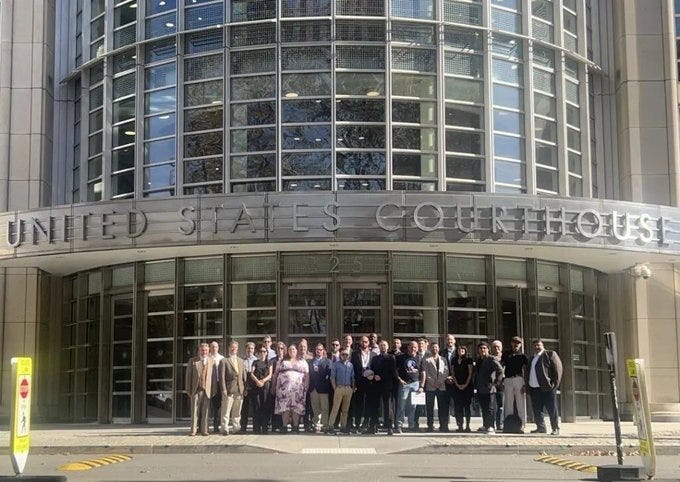
75 Hexicans gathered outside the Eastern District of New York courthouse on October 31, 2024 — the day of the SEC motion to dismiss hearing. (Photo:@ivamichele / X)
This is what a financial movement looks like when belief starts to outpace scrutiny.
The Ecosystem: $1 Billion and a 95% Crash
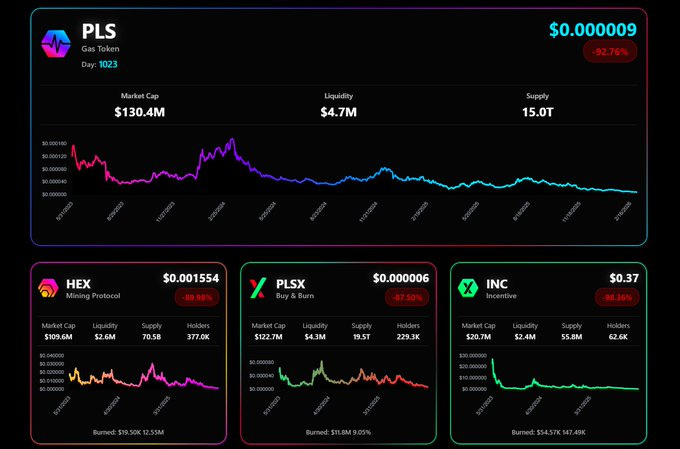
HEX on PulseChain, PLS, PLSX and INC — from all time high to present. Source:https://www.pulsechainstats.com/
After HEX came PulseChain — a fork of Ethereum that Heart claimed would be faster, cheaper, greener, and better. Then PulseX, its native decentralized exchange.
To fund them, Heart invented something called a sacrifice phase. You couldn’t buy tokens. That would be a security. Instead, you donated to charity — and in exchange for your charitable donation, you received tokens with no legal guarantee of value whatsoever. Technically brilliant. Legally untouchable. The PulseChain sacrifice brought in approximately $670 million from real external participants. PulseX followed, pulling in over $1 billion from more than 115,000 wallet addresses — making it one of the largest unofficial funding rounds in crypto history at the time. Combined: roughly $1.7 billion in genuine outside money. Legitimate charities received real donations. The SENS Research Foundation — focused on anti-aging science — received over $20 million in the first 48 hours.
There was another incentive baked in from the start: because PulseChain was a full fork of Ethereum’s entire state, anyone who held or staked HEX on Ethereum automatically received a free copy of their HEX balance on PulseChain at launch. Same for any other Ethereum-based tokens they held. It was a powerful carrot — existing HEX holders had every reason to want the new chain to succeed, because they’d already been handed a stake in it.
This wasn’t just a carrot for HEX holders. At the moment PulseChain went live, every single Ethereum wallet in existence received a free copy of every token it held — not just HEX, but every ERC-20 token on the entire Ethereum blockchain. Billions of dollars worth of tokens, duplicated overnight and handed to their holders for free. No other blockchain launch in history had done anything like it. If you held ETH, you got PETH. If you held USDC, you got a PulseChain copy. If you held obscure tokens from 2018 that had long since gone to zero — you got those too. It was the largest airdrop in crypto history, and most of the people who received it didn’t even know it had happened.
Then PulseChain launched in May 2023.
It was chaos. Fake versions of PLS proliferated. The official bridge didn’t output native tokens correctly. Smart money had sold HEX on Ethereum before the launch even happened. By May 13, the crash was already underway. Investors who had locked up billions in tokens watched as the price peaked nine days after launch — then spent the next two years falling.
The numbers, pulled directly from on-chain data at the time of writing this article, tell the full story:
HEX on Ethereum hit an all-time high of $0.513. It now trades around $0.0007363 — a drop of approximately 99.9%.
HEX on PulseChain peaked at $0.04079 after launch. It now trades around $0.001983 — down approximately 95.1% from its high.
PLS (PulseChain’s native token) hit an all-time high of $0.0002881. It now trades around $0.0000099 — down approximately 96.6%.
PLSX (PulseX) peaked at $0.00014. It now trades around $0.0000069 — down approximately 95.1%.
Its largest centralized exchange, OKX, delisted the PLS trading pair in August 2023 — a significant blow to PLS’s presence on mainstream exchanges.
The people who lost the most weren’t institutions or sophisticated traders. They were regular people who’d watched his videos and believed, for the first time, that someone in finance was actually speaking to them.
The Enigma Diamond, the McLaren & the SEC

The Enigma — a 555.55 carat black diamond, the largest in the world, purchased by Richard Heart for approximately $4.3 million. The SEC alleged the funds came from investors. (Photo: Sotheby’s)
In July 2023, the SEC came for him.
The charges were extensive. Unregistered securities offerings. Over $1 billion raised from investors. And then the part that made headlines everywhere: Heart had allegedly diverted at least $12 million of investor funds for personal luxuries.
The specifics were extraordinary. A 555-carat black diamond — the largest in the world — called The Enigma, purchased for approximately $4.3 million. A Rolex worth $1.38 million. A McLaren for $534,916. A Ferrari Roma for $314,125.
At a conference earlier that year, Heart had said: “I want to be the best crypto founder that’s ever existed. I like owning the world’s largest diamond.”
The SEC also alleged something more technically damning: that during HEX’s presale, what appeared to be $678 million in Ethereum invested was actually largely recycled funds — money moved in circles to create the illusion of massive demand. Real investment: approximately $34 million. The inflation of demand: roughly 20x.
The SEC charging Richard Heart didn't happen in isolation. The broader shift in how regulators are classifying crypto assets is covered in depth here.
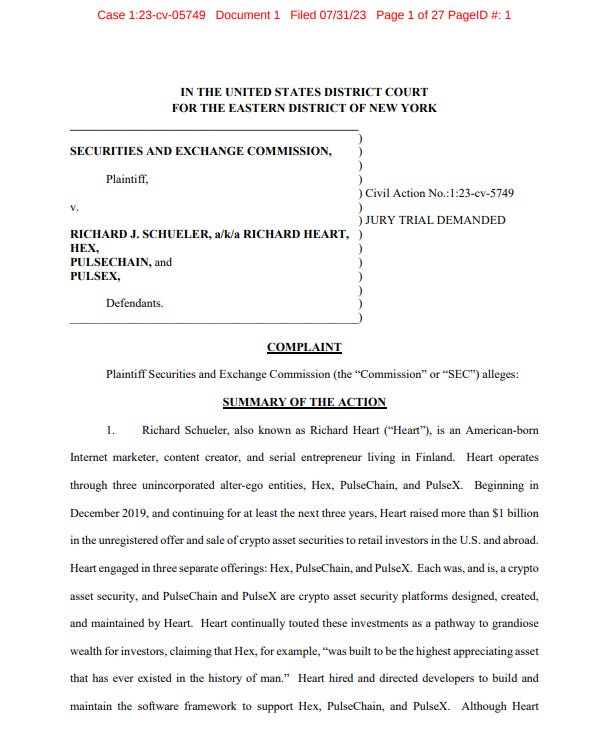
The SEC complaint filed against Richard Heart, HEX, PulseChain and PulseX on July 31, 2023. Case number 1:23-cv-05749, Eastern District of New York. The case was dismissed in its entirety in February 2025. (Source:SEC.gov)
Heart denied everything. Already living in Helsinki — and apparently invisible to every process server the SEC sent — he did something almost nobody expected.
He won.
The Win Nobody Predicted
In February 2025, Federal Judge Carol Bagley Amon dismissed the SEC’s case entirely.
Not on the merits. Not because Heart was found innocent. But because the SEC couldn’t establish jurisdiction over a Finland-based US citizen whose online communications were, in the court’s words, “untargeted, globally available information” not specifically directed at American investors.
By April 2025, the SEC announced it would not refile. Case closed. Total victory.
His lawyer called it the only
SEC crypto enforcement action ever dismissed
in its entirety by a federal judge. Heart called it a win for open-source software, free speech, and decentralized finance.
He wasn’t entirely wrong. The SEC had named software code itself as a defendant. That’s a precedent that should concern anyone who builds on a blockchain.
But here’s what the dismissal didn’t say: it didn’t rule on whether the underlying allegations had merit. It said America couldn’t prove it had the right courtroom.
The Part That Has Nothing to Do With Crypto
While Heart was celebrating his SEC victory,
Interpol was circulating his Red Notice internationally.
The core charge is gross tax evasion — hundreds of millions of euros, multiple years of unfiled returns. The kind of number that doesn’t happen by accident.

Richard Heart’s Interpol Red Notice, first issued December 2024. The notice remains active on charges of gross tax evasion totaling hundreds of millions of euros. (Screenshot via Coinpaper / Source: Interpol)
When the Red Notice was first issued in December 2024, it also included an assault allegation: that Heart physically attacked a 16-year-old, dragging them by the hair into a stairwell and striking them repeatedly in the face. Those assault charges have since been removed from Interpol’s website. The tax evasion case, however, remains very much active.
Finnish police, executing search warrants in 2024, found $2.6 million worth of luxury watches — 20 of them, mostly Rolexes — in an apartment in Espoo that appeared to have been abandoned in a hurry.
Heart, posting from an undisclosed location, responded to the Red Notice on X: “It feels great to be wanted.”
The New Project ProveX & The Mixer
He hasn’t stopped.
In November 2025, Heart launched ProveX — a new project promising to replace crypto exchanges entirely using cryptographic proofs. Another sacrifice phase. Another promise of revolution.
In early March 2024, wallets linked to Heart converted what on-chain analysts believe were sacrifice-phase stable coins into approximately 162,937 ETH — worth around $619 million at the time — at a price of roughly $3,800 per ETH. That was near the top of Ethereum’s 2024 cycle.
On the surface it looks like a bad trade. But consider the timing: the Finnish arrest warrant came in September 2024, six months later. The Interpol Red Notice followed in December 2024.
Here’s the thing about stable coins like USDC and USDT that most people don’t know: they can be frozen. Circle and Tether — the companies behind those coins — can blacklist any wallet address at the request of law enforcement, making the funds completely immovable. ETH cannot be frozen. It’s truly decentralized, held by no issuer, controlled by no company.
Nobody can say what he was thinking. But look at the timing. A man who knew the Finnish warrant was coming, sitting on hundreds of millions in stable coins that law enforcement could freeze with a phone call — quietly moved everything into ETH. Months before the warrant dropped.
Then in October and November 2025, the ETH moved again. On-chain researchers tracked at least 21 addresses linked to Heart’s ecosystem depositing over 116,000 ETH into Tornado Cash across a series of transactions — beginning October 19 with $37 million, followed by $102 million on October 26, with further deposits continuing through November. Approximately 2.5 months later, on January 6, 2026, the ETH began moving out — 128,808 ETH consolidated and sent directly into the ProveX sacrifice wallet. Arkham Intelligence traced every step.
Then Arkham Intelligence analyst Emmett Gallic started looking at the ProveX sacrifice numbers. On the surface — $410 million raised. Impressive. But Gallic alleged that roughly $400 million of that didn’t come from the community at all. It came from Heart himself, routed through Tornado Cash, split across more than 950 wallet addresses, then funnelled into the sacrifice. Strip that out and real community participation was somewhere between $10 and $16 million.
Some people actually think that makes ProveX the more interesting bet. PulseChain launched into $670 million from 115,000 participants — the valuation was already crowded from day one. ProveX had a fraction of that. If it ever gets traction, the early entry looks very different. That’s the bull case anyway.
Whether any of that plays out is another story. The ETH Gallic traced had already lost significant value by the time it moved — a paper loss of around $280 million. And plenty of people who’d been through the PulseChain and PulseX sacrifices said publicly they were done. Burned once. Not twice.
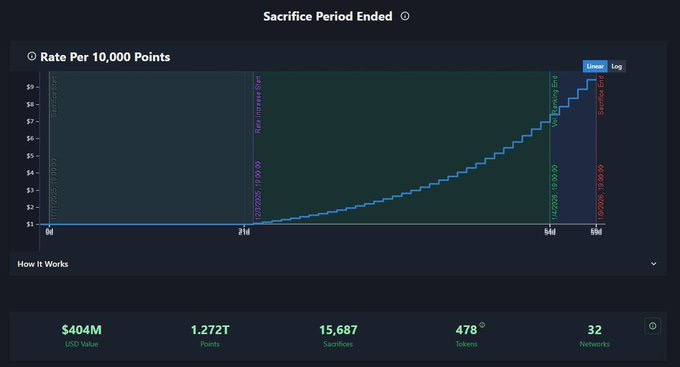
The live ProveX sacrifice interface at provex.info Heart’s third sacrifice phase, launched November 2025 from an undisclosed location
That’s a dramatically lower entry valuation than PulseChain — which some observers argue actually makes ProveX the more interesting bet. PulseChain launched into a $670 million sacrifice from 115,000 participants, meaning early price discovery was already crowded. ProveX, by contrast, launched with a fraction of that community capital. If the project gains traction, the math could favor those who got in early at a lower base.
Whether that upside ever materializes is another question entirely. The ETH Gallic traced had allegedly declined significantly in value since being deposited into Tornado Cash — a paper loss of approximately $280 million — and many former believers publicly said they were sitting this one out, citing unrecovered losses from previous sacrifice phases.
The Part Nobody Wants To Say Out Loud
Here’s the thing.
Richard Heart is facing serious allegations. He is wanted by Interpol. He may yet face a courtroom in Europe. All of that may be true simultaneously with this:
He wasn’t wrong about the system.
The financial system is designed to extract wealth from people who have less of it. Inflation does quietly rob savers. Banks charge fees that disproportionately punish the poor. Wall Street operates on information asymmetries that regular investors will never overcome. The traditional certificate of deposit pays a pittance while the bank profits off your money.
These aren’t fringe ideas. They’re in every economics textbook. The difference is nobody had ever explained them to regular people in plain English before. Heart did. And once you understand how inflation actually works, how banks actually make money, how the system is actually structured — you can’t unsee it.
That education is real. It doesn’t disappear because the man who delivered it is facing legal trouble.
PulseChain itself is real technology. A proof-of-stake chain with three-second block times, near-zero fees, and full Ethereum compatibility — built and running, processing transactions every day. The ecosystem Heart created didn’t vanish because the tokens dropped. The infrastructure exists. The community exists. Hundreds of thousands of wallets are still active on PulseChain right now.
Crypto has a long history of projects that looked finished and came back. Bitcoin was declared dead dozens of times. Ethereum was written off after the DAO hack. Projects don’t die because the tech fails. They die because the people leave. The Hexicans haven’t left.
The Hexican community has been through the SEC lawsuit, through the post-launch crash, through the Interpol Red Notice, through the OKX delisting. They’re still here. That kind of conviction — however bruising the journey — is exactly what separates communities that rebuild from ones that dissolve.
The legal issues that surround Richard Heart are real and could end badly. But it might not, time will tell. But while that plays out in courtrooms, PulseChain keeps producing blocks. Devs are still building. The wallets are still active. That doesn’t happen with a dead project.
Whatever you think of the man (and there is plenty to think) the idea he was selling deserves to outlast the controversy surrounding him. A financial system that works for regular people, not just the ones who already have everything. Decentralized. Transparent. Unstoppable.
That idea isn’t finished. Not even close.
Richard Heart remains at large. The Interpol Red Notice remains active. The legal road ahead in Europe is uncertain. But PulseChain is still running. The community is still here building. And the reason people showed up in the first place, a broken financial system that needed a real alternative, hasn’t gone anywhere either.
The story isn’t over. It’s just getting started.