


Today Would Have Been His 33rd Birthday
Today is March 28, 2026.
Nikolai Mushegian was born on this date in 1993. He never made it to 30.
Most people in crypto have used something he built without knowing his name. The DAI stablecoin. Wrapped Ether. The Balancer protocol. The smart contract security architecture that saved MakerDAO from the same exploit that wiped out The DAO in 2016. He co-designed the collateralized debt position — the foundational mechanism behind decentralized lending. He built DeFi’s plumbing before DeFi had a name.
He died on October 28, 2022, in Puerto Rico.
The official cause of death was drowning.
He had posted his final tweet four hours and eighteen minutes before his body was found.
The Architect
Born in Lexington, Kentucky, to parents who had emigrated from the Soviet Union. Both scientists. He grew up between Kansas and California. By high school he was a drum major and a multi-instrumentalist. At Carnegie Mellon, he enrolled in computer science. Blockchain was not on the curriculum — so he designed and taught the course himself as a student in 2014.
After graduation he went straight into BitShares, which he had been contributing to since CMU. Then in 2015, alongside Rune Christensen, he co-founded MakerDAO — the first decentralized stablecoin project on Ethereum.
What followed was some of the most consequential infrastructure work in the history of decentralized finance.
He designed the Single-Collateral DAI system that launched in December 2017. He co-authored the Dai Purple Paper, the technical specification for Multi-Collateral DAI. He led the team that built Wrapped Ether in 2016, making ETH compatible with the ERC-20 standard and unlocking the entire token ecosystem that followed. In the weeks before The DAO hack of 2016, he identified the same recursive withdrawal vulnerability inside MakerDAO’s code and patched it before anyone could exploit it. Rune Christensen after his death: “Nikolai was one of the only people in the early days of Ethereum and smart contracts who was able to predict the possibility of smart contract hacks and invented the security-oriented approach to smart contract design we know today. Maker would have been toast without him.”
In 2019, he donated 3,200 MKR tokens — worth approximately $1.4 million — to Carnegie Mellon, establishing the Mushegian Research Fund and the Mushegian Endowed Computer Science Fellowship. His stated concern at the time: “I am very concerned about the increasing rent-seeking behavior from some of the big players in this space, and also from existing banks and tech giants.”
He was 26 years old.
The Break
He left MakerDAO in 2018.
The reason was not money. It was a philosophical fracture over what DAI was supposed to be.
MakerDAO was moving toward using USDC as collateral to help stabilize DAI’s peg. USDC is issued by Circle, a regulated U.S. company. Circle can freeze any USDC wallet on a government order — and has done so repeatedly. I covered that in detail here.
To Mushegian, accepting USDC as DAI collateral meant accepting that a government could, if it chose, pull the rug on DAI’s reserves. That was not a technical compromise. It was a betrayal of the entire purpose of building a decentralized stablecoin. You cannot build a censorship-resistant financial system on a censorable foundation.
He walked out and spent the next four years trying to build what DAI was supposed to be.
First came RAI — a stablecoin backed entirely by Ethereum with no dollar peg and no centralized collateral. Then came RICO — a governance-minimized stablecoin. His description: the spiritual successor to DAI, designed without compromises. A system so mathematically sound it would not need a governance vote to maintain its peg, and could not be frozen by anyone, ever.
He moved to Puerto Rico in 2021. He lived in a reported $6 million home in the Condado neighborhood of San Juan. He worked on RICO. And he started posting things on Twitter that alarmed the people who knew him.
The Last Tweet
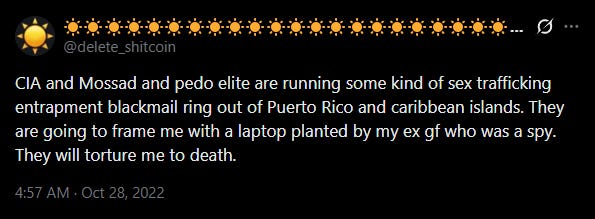
Posted at 4:57 AM on October 28, 2022, from his account @delete_shitcoin.
At 9:15 AM, a surfer found his body in the water off Ashford Beach in the Condado neighborhood of San Juan.
He was fully clothed. His wallet was still on him. There was a small laceration on his skull.
Ashford Beach is a surf spot. Hotels post warning signs telling tourists not to swim there because of the riptides. There was no indication Mushegian had been surfing. He did not have a board. The beach behind Ashford Hospital in Condado is where his body was recovered.
This Was Not the First Warning
The October 28 tweet did not appear from nowhere. He had been sounding alarms for months.

By September the language had shifted. He was no longer talking about preparing. He was talking about outcomes.
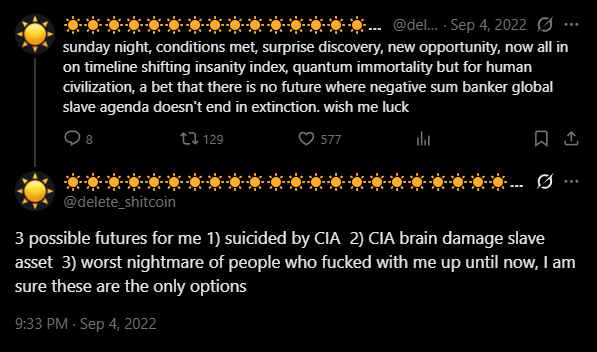
A week later he wrote about the mechanics of control: “The strange people we are fighting use two main mechanisms: debt and extortion. They complement each other.” Then came October 28.
These were not casual posts. He was not trolling. The escalation spans four months. The final tweet names a mechanism — sex trafficking entrapment. A location — Puerto Rico and the Caribbean. A method — a planted laptop, a spy posing as a girlfriend. A result — torture.
Hours later, he was dead.
What the Investigation Found
Puerto Rico police found no signs of violence in their preliminary examination of his body. The homicide division investigated — standard procedure for all drowning deaths in Puerto Rico. A source close to the investigation told Decrypt they believed factors pointed toward suicide. His family said they did not suspect foul play.
The official autopsy ruling: drowning, classified as non-homicide.
His father had flown to Puerto Rico before his death specifically because he was worried about him. He was there when it happened.
Crypto investor Michael Terpin, who knew Mushegian, told the New York Post: “I didn’t know him to be the type to go out swimming like that, especially in such rough water. I don’t see any way this could have been an accident.”
Ameen Soleimani — CEO of SpankChain and co-founder of RAI, Mushegian’s own stablecoin project — was direct: “My money is on him being murdered. He was found drowned 4 hours after his riskiest tweet ever. He had all year to drown randomly or be mugged. So it seems unlikely that his death was unrelated to his tweet.”
A source quoted in the New York Post piece said this: “Some of his paranoia was based on fact. He’d discover things. He knew things.”
Rune Christensen told Decrypt that he had spoken with Mushegian three months before his death. Mushegian “seemed happy to be building his new stablecoin RICO. But he was also worried about a criminal group he believed was trying to interfere with his work.”
Brock Pierce, the cryptocurrency entrepreneur who knew him, chose his words carefully: “Brilliant people sometimes walk the edge of insanity.”
His Nightmare Became Federal Law
On July 18, 2025, the GENIUS Act was signed into law — the first comprehensive federal framework governing stablecoins in the United States.
Read what it does. Only permitted issuers may issue stablecoins for U.S. persons: subsidiaries of insured banks, federally licensed nonbank entities, or state-licensed entities below $10 billion issuance. All reserves must be held in dollars, short-term Treasuries, or approved government assets. All issuers are financial institutions subject to AML and Bank Secrecy Act compliance. The government decides who is permitted. The government decides what counts as an approved reserve. The government can remove that permission.
Mushegian left MakerDAO in 2018 because DAI was drifting toward USDC collateral. He built RAI to prove you could have a stablecoin with no centralized dependencies. He built RICO to prove you could have a stablecoin with no governance, no government-approachable layer, nothing to freeze. He spent the last four years of his life in direct technical opposition to the architecture the GENIUS Act just codified.
That architecture is now law. RICO is a GitHub repository with early commits and no launch.
As I argued when the GENIUS Act passed: calling it innovation is a misdirection. What it builds is a permission structure. The government decides who gets to issue digital dollars. That is not decentralization. It is the old system wearing a new interface. Full analysis here.
The week Mushegian died, MakerDAO approved a Coinbase custodian partnership. Five days after they recovered his body. The protocol he built to escape the banking system was officially partnering with a publicly traded exchange. MakerDAO has since rebranded as Sky Protocol. DAI is now substantially backed by real-world assets and USDC. The centralization he predicted, and then fled, and then spent four years trying to counter — it happened anyway.
The Caribbean
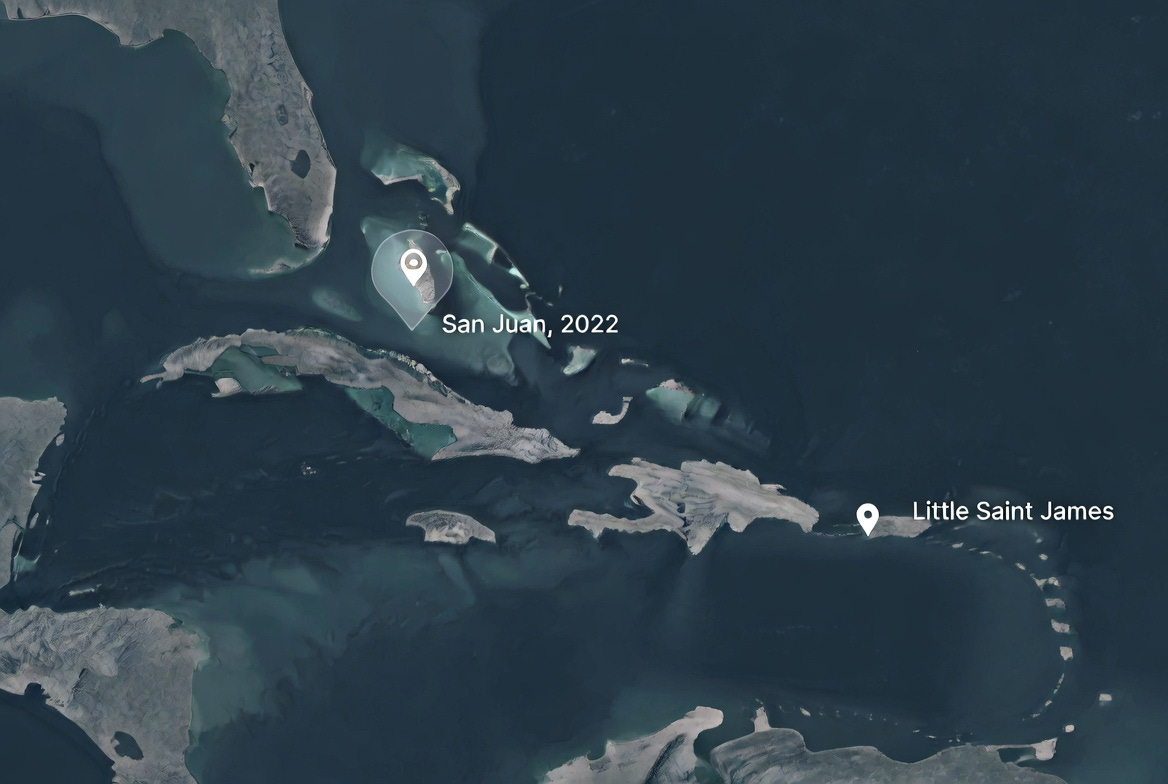
His final tweet was specific about location. Puerto Rico and the Caribbean islands. Sex trafficking. Entrapment. Blackmail. Intelligence agencies.
In February 2026, the Department of Justice released files as part of the Epstein document disclosures. Those files confirmed that Jeffrey Epstein invested in Bitcoin’s foundational infrastructure and cultivated relationships directly with figures across the crypto industry. A separate investigation by 26th Edition goes deeper on the missing Epstein files and what they reveal about his network. That piece is here.
Epstein’s operation ran out of the Caribbean. His island — Little Saint James — sits in the U.S. Virgin Islands, approximately 70 miles from where Mushegian drowned.
Mushegian named the Caribbean in October 2022. He named intelligence agencies. He named sex trafficking entrapment. He named blackmail.
He posted that at 4:57 AM.
Whether that constitutes paranoia, knowledge, or something in between is a question this article cannot answer. What it can do is note that the thing he described is now at least partially documented in federal records released after his death.
The CIA’s relationship with Bitcoin’s origins is a separate thread I have been investigating. That piece is here. The question of who funded crypto’s foundations — and what they intended to extract from it — runs underneath a lot of what happens in this industry. Mushegian was building against that structure. He named it directly. He died before he could finish what he was building.
The Pattern
Mushegian was not the only prominent crypto figure to die in that period.
On November 23, 2022 — less than four weeks after Mushegian — Tiantian Kullander, co-founder of Amber Group, died in his sleep at 30 years old. No cause of death was ever publicly confirmed. His company was weeks away from closing a $100 million funding round.
On November 28, 2022 — five weeks after Mushegian — Vyacheslav Taran, founder of Forex Club and a prominent figure in European crypto, died when his helicopter crashed near the French-Italian border. He was the only fatality. His pilot survived.
Three crypto figures. Six weeks. All dead.
Each death has an individual explanation. The helicopter crash was ruled an accident. Kullander’s death was attributed to natural causes. Mushegian’s was ruled a drowning. Taken separately, each is tragic but not inexplicable. Taken together, in the same six-week window during a period of maximum crypto industry turbulence — the FTX collapse happened in that same window — the pattern is at minimum worth noting.
What Remains
His RICO project still exists in a GitHub repository, but the code is partial. The vision is documented. The stablecoin that might have changed the entire architecture of money was never finished.
The ecosystem he built is now subject to the permission structures he spent his life trying to prevent. What he named in that final tweet is now, at minimum, contextually corroborated by federal document releases. The people who knew him best said some of his paranoia was grounded in fact.
He posted his final tweet at 4:57 AM. His body was found at 9:15.
Fully clothed. Wallet in his pocket. A beach posted with warning signs. A skull laceration noted and moved past and a father who had come to Puerto Rico because he was worried.
Today would have been his 33rd birthday.
The official cause of death is drowning.
I am not telling you what to conclude. I am telling you the facts. Make with them what you will.
R.I.P. Nikolai Mushegian. March 28, 1993 — October 28, 2022.
If you found this article worth reading, share it with one person who should know this story.
Not subscribed yet? Subscribe here.
Do you think Nikolai Mushegian knew something? Or did the system he was fighting simply break him? Leave it in the comments.
Related Investigations: Did the CIA Create Bitcoin? | Epstein and Bitcoin | The GENIUS Act Is Not About Innovation | Circle Has the Power to Freeze Your Wallet | Tether: The Stablecoin Running the World