


Satoshi Nakamoto — genius, anarchist, ghost. Or CIA asset? Let’s go down the rabbit hole.
The 1,000,000 BTC Question
I get asked the same question all the time. Who is Satoshi?
When I first got into Bitcoin I believed in the ideology. Satoshi’s vision. The whole thing. Still do. But after a while something started bothering me.
How is Satoshi still anonymous?
Think about that seriously for a second. The CIA and NSA — two of the most powerful intelligence agencies on the planet — cannot identify the person who built an alternative financial system designed to circumvent everything they protect. A system that moves billions of dollars outside of their control every single day.
Either they genuinely don’t know. Or they do know and they’re not saying anything.
I think it’s the second one. And I’m going to show you why.

The Name That Shouldn’t Be Ignored
Start with the name itself. Satoshi Nakamoto. Japanese name, Japanese structure — family name first. So it reads Nakamoto Satoshi.
Break it down. Naka means center or central point. Moto means origin. Put them together — central origin. Nakamoto literally means central origin.
Satoshi means wisdom or intelligence.
Central origin of intelligence. Go ahead and tell me that’s a coincidence.
Maybe it is. Names can be stretched to mean anything if you try hard enough. But pair it with everything else and it stops feeling like coincidence very quickly.
The NSA Paper Nobody Talks About
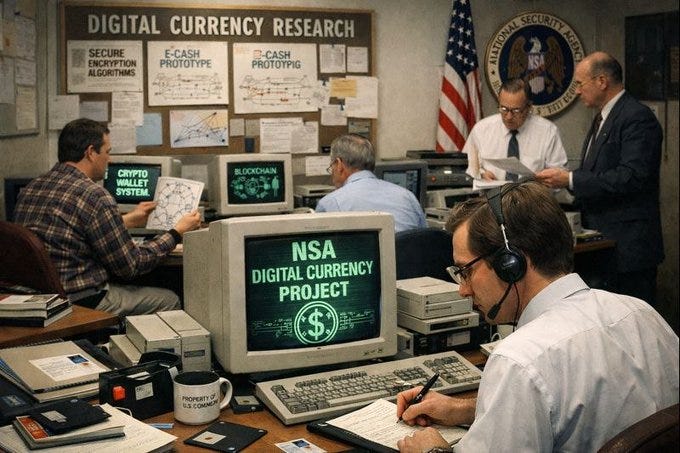
1996. A paper gets published inside the NSA’s Cryptology Division. The title: “How To Make A Mint: The Cryptography of Anonymous Electronic Cash.”
Written by Laurie Law, Susan Sabett and Jerry Solinas. All NSA employees. All working in cryptography. The paper is a technical blueprint for creating a digital currency system — one that is anonymous, electronic, and impossible to counterfeit.
This was 1996. Twelve years before Bitcoin.
Inside the references of that paper is the name Tatsuaki Okamoto — a prominent Japanese cryptographer whose name bears more than passing resemblance to the pseudonym that would later change the financial world.
Draw your own conclusions.
What the paper proves beyond any doubt is this — the NSA was not just aware of the concept of digital cash in the 1990s. They were actively researching how to build it.
SHA256: The NSA’s Algorithm Running Bitcoin
Here is the fact that I think should end the debate about whether intelligence agencies had any involvement in Bitcoin’s technical foundation.
Bitcoin runs on SHA256. Every single transaction. Every block. Every proof of work calculation. SHA256 is the engine.
The NSA invented SHA256. US Patent 6829355B2. Filed March 5, 2001. Published December 7, 2004. The named inventor is NSA cryptographer Glenn M. Lilly.
Seven years after the NSA patents SHA256, Satoshi Nakamoto builds Bitcoin on top of it. Not one of dozens of other available algorithms. Not a custom-built function. The NSA’s algorithm.
Bitcoin doesn’t run SHA256 once. It runs it twice. Satoshi called it a safety precaution. A safety precaution against what, exactly?
The Suspects
My position is that Satoshi wasn’t one person. It was a group. And that group had help.
The names I keep coming back to: Len Sassaman. Hal Finney. Adam Back. And somewhere behind them, the NSA and CIA providing the infrastructure that made it all possible.
Of all of them Sassaman is the one who keeps me up at night.
Len Sassaman: The Ghost In The Machine

Leonard Harris Sassaman was born April 9, 1980 in Pennsylvania. By eighteen he was already working on the Internet Engineering Task Force — the body that maintains the core protocols of the entire internet. By his early twenties he was at Network Associates working on PGP encryption software alongside a man named Hal Finney.
That name matters. Hal Finney received the first ever Bitcoin transaction from Satoshi Nakamoto.
Sassaman moved to Belgium to do his PhD at the Katholieke Universiteit Leuven — one of Europe’s most respected cryptography institutions — under David Chaum, the man who invented digital cash in 1989, and Bart Preneel, one of the most accomplished cryptographers alive. He was embedded at COSIC — the Computer Security and Industrial Cryptography research group.
Now here’s the detail that stopped me cold when I found it.
The Bitcoin whitepaper cites references from a book — the “20th Symposium on Information Theory in the Benelux.” A 1999 cryptographic research compilation from a symposium held in Belgium. This book was not available online until 2020. Before that it existed only in physical form. It was stored at one library — the Katholieke Universiteit Leuven.
The same university where Sassaman was working.
Whoever wrote the Bitcoin whitepaper had physically held that book. They were in Leuven.
The geographic evidence doesn’t stop there. Look at the Genesis Block — the very first Bitcoin block ever mined, January 3, 2009. Satoshi embedded a headline from The Times of London inside it. A British newspaper. Throughout his forum posts and emails Satoshi used British spelling consistently. Color. Maths. Grey. Sassaman was American but had been living in Belgium for years. His own writings show the same British spelling patterns.
Look at Satoshi’s activity timeline. Development surged during university holiday periods. It slowed during term time. That is exactly the pattern of a PhD candidate running a secret project alongside a full research load.
Then there’s the blockchain tribute.
When Sassaman died by suicide on July 3, 2011 the cryptography community was devastated. Security researcher Dan Kaminsky — the man who had tried and failed to hack Bitcoin years earlier — created an ASCII art memorial to Sassaman and had it permanently embedded into Bitcoin’s blockchain. He announced it at Black Hat 2011.
Think about what that means. The people who understood Bitcoin most deeply — the ones closest to the network — chose to immortalize Sassaman inside the blockchain itself. Not a forum post. Not a website. The blockchain. Permanently. Forever.
Satoshi sent his last known communication in April 2011.
Sassaman died in July 2011.
Two months apart.
The NSA Was Already Watching
In 2013 Edward Snowden leaked classified documents revealing the NSA had a dedicated program to surveil Bitcoin users. It was called MONKEYROCKET. The program used full-take surveillance to track Bitcoin activity — pinpointing users’ IP addresses through the NSA’s XKeyscore software. When The Intercept approached the NSA for comment they said nothing.
Bitcoin launched in January 2009. By 2013 — just four years later — the NSA had a dedicated named program with its own infrastructure to track its users.
You don’t build that from scratch in four years for something you had no prior knowledge of.
The NSA was tracking Bitcoin users by 2013. By 2026, Russian intelligence found a more direct route into crypto wallets. The DarkSword iOS exploit showed exactly how.
The One Problem
Good journalism means presenting the evidence against just as clearly as the evidence for.
In March 2014 — nearly three years after Sassaman’s death — Satoshi Nakamoto’s account on the P2P Foundation forum posted a message. “I am not Dorian Nakamoto.” A response to a Newsweek article that had wrongly identified a Japanese-American engineer as Bitcoin’s creator.
If Sassaman was Satoshi that post is inexplicable. Dead men don’t update forum accounts.
Three possible explanations. One — Sassaman wasn’t Satoshi and the theory, however compelling, is wrong. Two — Sassaman was part of a group operating under the Satoshi identity and another member posted the denial. Three — the account was accessed by someone else entirely to protect the real identity.
None of them can be proven. All of them are possible. That’s where the evidence sits right now.
The Real Risk To Bitcoin
Here’s what I want to leave you with.
The CIA creating Bitcoin is a rabbit hole. It’s a fascinating one and I believe the evidence points somewhere real. But even if it’s true — even if every piece of this theory is correct — it doesn’t change what Bitcoin is now.
The code is open source. The network is decentralized. No single government, agency or institution controls it. Whatever it was at the beginning, what it became is something they can’t put back in the box.
The real threats to Bitcoin aren’t in its origin story. They’re happening right now in plain sight. BlackRock ETFs. Bank custody solutions. Stable coins with freeze functions. CBDCs waiting in the wings. These are the Trojan horse. The attempt to centralize from the outside what they couldn’t control from the inside.
Epstein's connections to this same intelligence infrastructure go further than Bitcoin. His funding of UAP science is a story almost nobody covered.
Don’t get lost in the who. Understand who is attacking it now and why.
Self custody. They cannot confiscate what they cannot reach.
What do you think? Reply below.